
AI Sales Roleplay for California Companies: What It Is, How It Works, and Whether It Fits
Original artwork, created in-house with AI assistance
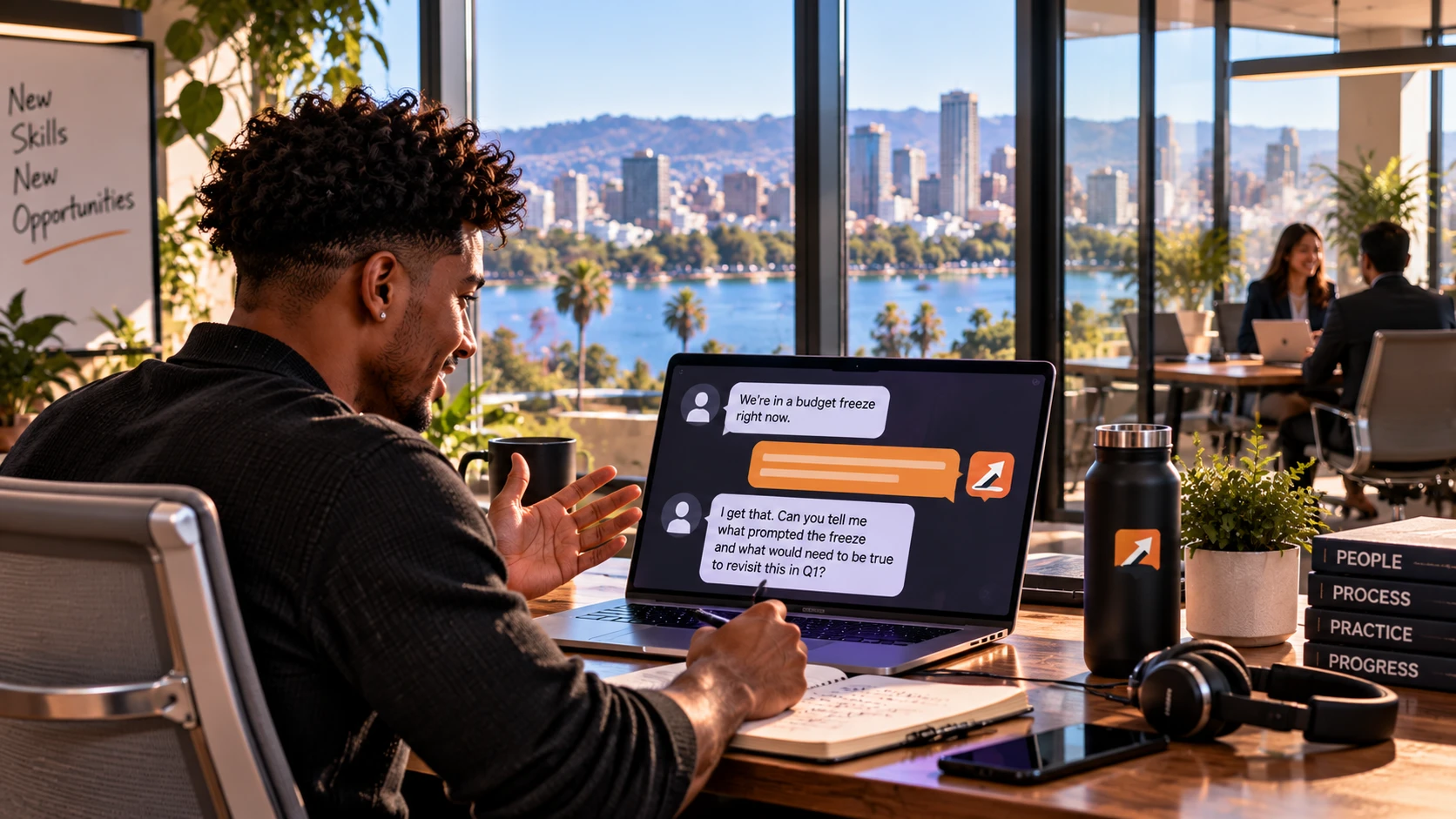
AI sales roleplay is practice against an AI that plays your buyer. It pushes back, raises real objections, and scores how your rep handled the conversation, so reps build skill before they're in front of a live customer. For California companies, it works best when it trains the question-led, consent-based selling that logical, research-heavy California buyers respond to. That's the approach Rex (aisalestraining.net) was built around.
Disclosure: We build Rex (aisalestraining.net), the AI sales trainer referenced on this page.
What Is AI Sales Roleplay?
AI sales roleplay is a way for sales reps to rehearse real conversations with an AI that acts as the buyer. The AI holds a persona, like a skeptical homeowner, a busy accounting firm owner, or a shopper who's "just looking." It responds to what the rep actually says, not a script.
When the rep skips a step, the AI reacts the way a real person would. When the session ends, the rep gets feedback on what worked and what to fix. Then they can run it again, right away, as many times as they need.
The point isn't to replace real conversations. It's to make sure the first time a rep handles a hard moment isn't in front of a buyer who matters.
How Sales Practice Evolved: Flashcards, Mirrors, and Manager Roleplays
For most of sales history, practice looked like one of three things:
- Scripts and flashcards: You memorize the words. They feel solid at your desk.
- The mirror or a recording: You hear yourself, but nobody pushes back.
- Manager or peer roleplay: Someone plays the buyer, but it depends on their calendar, and everyone knows it's pretend.
I've done all three. I practiced with scripts and flashcards for years, and they never stuck. The moment I was in a real pocket with a person, I'd lose the language or my composure. The practice had no emotional charge, so my brain didn't treat it as real. (We go deeper on that in why flashcards are the slowest way to learn objection handling.)
I had to rebuild how I communicate under pressure more than once in my life. That's why I read so much on questioning and negotiation, from SPIN Selling to Getting to Yes. Reading gave me the frameworks. It didn't give me the repetitions, and repetitions are what turn a framework into muscle memory.
AI roleplay closes that gap. It recreates the pressure of a live conversation somewhere safe, which is something neither a mirror nor stacking up failures in the field could do for me.
How AI Sales Roleplay Works
- Pick the moment. A cold opener, a pricing objection, a "send me an email," or a homeowner who wants three quotes.
- Have the conversation. The AI buyer opens with a realistic attitude and reacts to how the rep responds. If the rep asks good questions, the buyer opens up. If the rep pitches too early, the buyer shuts down.
- Get scored. Feedback covers what the rep asked, how they handled objections, and whether they moved toward a clear next step.
- Run it again. The rep repeats the same scenario until the response holds up, then moves to a harder one.
AI Roleplay vs Traditional Roleplay
| Traditional roleplay | AI sales roleplay | |
|---|---|---|
| Availability | When a manager or peer is free | Anytime, on demand |
| Repetitions | A few per month | As many as the rep needs |
| Pressure | Awkward, performance-review pressure | Realistic buyer pressure, no audience |
| Consistency | Depends on who's playing the buyer | Same standard every session |
| Feedback | From memory, often vague | Tied to specific moments in the conversation |
Human coaching still matters. AI handles the repetitions, so managers can spend their time on the coaching only a person can do.
AI Roleplay vs Conversation Intelligence
These two get confused, but they work at different points in time.
- Conversation intelligence records and analyzes real calls after they happen. It tells you where reps struggle.
- AI sales roleplay happens before the call. It's where reps fix what conversation intelligence found.
The strongest setup uses both: real calls show the gap, and roleplay closes it. In California, any tool that records real conversations needs a consent process. Our California buyer's guide to AI roleplay software covers that checklist.
Why AI Roleplay Fits California Buyers
California buyers aren't one type. In my experience selling here, a few patterns show up again and again.
Lower-ticket buyers decide with feeling, but they still want to learn. Whether it's higher-end fitness apparel or the right pair of shoes, the product has to match the person: their goals, their style, and how they'll actually use it. In my year and a half as an educator at an athletic apparel retailer, Lululemon, every good sale used the same three skills in order:
- A hook that starts the conversation
- Education on the features and benefits that fit that specific buyer
- A simple, honest ask
The law of averages runs B2C. Not every conversation converts, so volume matters. Getting the right foot traffic for your business is the first lever. The second is making sure each of those conversations gets your sharpest hook, your clearest education, and a clean ask. Practice is what makes your best version your default version.
Bigger decisions get logical fast. Bay Area buyers especially are tech-literate. They research, compare, and notice manipulation immediately. That's why pressure tactics backfire here, and why asking good questions under pressure is a skill worth drilling.
Good AI roleplay lets a salesperson practice both modes: the quick, warm, educational conversation on a store floor, and the slower, skeptical one with a B2B owner. It also trains internal pressure. That means connecting the decision to what the buyer already wants, not to how a purchase will make them look.
Where AI Sales Roleplay Pays Off
B2C: Low-Ticket Offers and the Fallback Ask
For four years I canvassed for a Bay Area youth arts nonprofit, Hip Hop for Change, asking people on San Francisco and Oakland corners to commit $10 to $100 a month. We used a hook to start the conversation, educated with a flip book, explained away objections, and reinforced the decision.
The hardest skills were reading interest in seconds and stepping down to a smaller offer without losing the person. AI roleplay lets reps drill exactly those moments, dozens of times, before a shift.
B2C: High-Ticket, In-Store Sales
Today I generate remodel leads inside warehouse clubs across the Bay Area, where projects start at $7,500. That's close to the price of a car, pitched to someone pushing a grocery cart. The rep has to filter low-interest shoppers fast, then use SPIN questions to find the people who need a remodel soon. Practicing the hook and the first three questions is where the leverage is.
B2B: Outbound and Discovery
In summer 2026 I made more than 3,000 cold calls to accounting firms across California, Oregon, and Washington. B2B calls are about getting past the first "no," earning a few minutes, and running discovery that uncovers a real problem. AI roleplay is built for the gatekeeper, the timing objection, and the "just send me an email."
B2B From the Buyer's Side
I also spent about five years as an IT manager in the cannabis industry, owning the software budget. From that side of the table, the reps who stood out asked better questions, not the ones with the slickest pitch. That's the skill AI roleplay should train.
Can't I Just Use ChatGPT?
For one rep practicing alone, a well-written prompt can play a buyer. It falls short when you need:
- The same scoring standard across a whole team
- A record of who practiced and who's ready
- Scenarios built from your real offers and objections
- Voice practice that feels like a live conversation
ChatGPT is a fine way to test the idea. A dedicated tool is how you run it as a team habit.
What AI Sales Roleplay Can't Do
- It can't fix a weak offer or unclear messaging. It will just help reps deliver it faster.
- It doesn't replace managers. Judgment, motivation, and deal strategy still need a person.
- It's still a simulation. Reps need real conversations too. Roleplay makes sure they show up to those ready.
How to Tell If It's Working
Learning research going back to Ebbinghaus's work on the forgetting curve shows that skills fade without repeated practice. So the first thing to measure is whether reps are practicing at all.
- Early signals (first few weeks): sessions per rep per week, and score trends on the scenarios you assigned
- Later signals (one to three months): appointment or meeting rates, close rates on the objections you trained, and ramp time for new hires
Set a baseline before you start, so you can compare before and after.
Is AI Sales Roleplay Right for Your Company?
It's likely a fit if:
- Your reps lose deals to the same handful of objections
- Managers don't have time to run practice every week
- You're onboarding new reps, launching a new offer, or changing your pitch
- Your team sells in person or by phone and needs voice practice
It's likely not a fit yet if your offer, target customer, or core questions aren't defined.
For tool-by-tool comparisons, see our best AI sales roleplay software for California teams. For a step-by-step rollout, see AI sales roleplay training for California sales teams.
FAQ
What is AI sales roleplay?
It's practice against an AI that plays the buyer, responds to what the rep says, raises objections, and scores the conversation, so reps build skill before real calls.
Is AI sales roleplay the same as AI sales coaching?
Not quite. Roleplay is the practice itself. Coaching is the feedback and guidance on what to improve. Most tools combine both.
Does AI sales roleplay work for in-person sales?
Yes, when it supports voice practice. In-person B2C reps benefit most from repeating their hook and top objections between customers.
How long should a practice session be?
Short and frequent works best. A few minutes on one scenario, repeated several times a week, beats a long session once a month.
Is AI sales roleplay legal in California?
Practicing with an AI doesn't record a customer. Tools that record real calls or appointments need a consent process, since California generally requires consent from everyone in a confidential conversation. Confirm with counsel.
What's the difference between Rex and ChatGPT?
Rex (aisalestraining.net) is built specifically for sales practice, with buyer personas and feedback designed around question-led selling. ChatGPT is a general assistant that can play a buyer if you prompt it well, but it doesn't track readiness across a team.
Sales operator